Author: admin

  • Run the Business, Transform the Business

    Day to day vs. long term transformation

    Every day, businesses face a constant tug-of-war. On one hand, leaders need to run the business, which involves the usual tasks such as managing staff, fulfilling orders, and ensuring a steady stream of revenue. On the other hand, leaders must incrementally transform the business to keep up with a constantly evolving landscape, including the impact of emerging technologies, shifting customer needs, and innovations from competitors. 

    The challenge for business leaders is to achieve a healthy balance between running and transforming the business. As James Schoen, Co-Founder of Trumbug says, “for small businesses, the biggest challenge is often taking the time to focus on strategy amidst competing priorities. You know it’s important, but it keeps getting pushed back due to more urgent tasks.”

    The dangers of not doing both

    Focusing only on running day-to-day operations can cause a business to become stagnant. While it might feel safe and comfortable to keep everything running smoothly, this approach leaves a company vulnerable to market changes and disruptions. Consider how many successful brick-and-mortar stores ignored the rise of online shopping and were outpaced by competitors who embraced e-commerce.

    On the flip side, concentrating solely on transforming and innovating without paying attention to your current operations can lead to chaos. Picture a scale-up that’s so obsessed with developing the latest technology that they neglect their core product. Their customers might become frustrated with poor service or unmet expectations, leading to a loss of trust and business. This imbalance can cause a company to fail despite having great potential.

    Being able to transform or grow a business while putting out the fires that come with running a business is difficult, but essential, so how can you ensure you aren’t neglecting transformation?

    First of all, have a forward-looking strategy, and refer to it often. Putting some time on the calendar to step back and consider whether you have the right ambition, and whether the way you spend your time is going to get you there. Cassie Maschoff explains that at Lottie’s Meats, they proactively “try to reassess and align on our strategy on a monthly basis. Because once you’re going and operating, it’s hard to find the time to sit back and strategize.”

    Second, think strategically about how you divide your budget, time, and team resources. Allocate a portion to running the business, to ensure smooth and efficient operations, and dedicate other resources to transformational initiatives that will help you achieve your future ambition. The resources you need can be defined in an initiative charter, which is a tool that provides an overview of a specific initiative.

    Lastly, track how you spend your time. As you review operational metrics to show how you are running the business, don’t forget to review progress against your strategic initiatives to show how you are transforming the business. Short, regular updates shine a light on how you are progressing towards your ambition, or whether you are getting stuck in fighting today’s fires. 

    By setting up these simple mechanisms, your transformational initiatives stand a better chance of not getting buried in the endless list of urgent to-do’s, setting you up for achieving your longer-term ambitions.

  • Defining Strategic Initiatives? Here’s 5 Tips to Keep in Mind

    After finally finishing your strategy on a page and identifying the initiatives that will see you achieve your ambition, you might feel a surge of excitement and readiness to dive in. But before you take the leap, it’s crucial to properly define your initiatives to ensure they’re truly effective. 

    Think of it like a home renovation project: your ambition could be something like: complete a residential renovation project in 6 months to increase the value of the property by $200K. Your focus areas could include modernizing the kitchen and redesigning the bathrooms. You layer in initiative titles for each focus area, like “upgrade appliances” (as part of modernizing the kitchen) that you are certain will contribute to your ambition, and pass that information on to a contractor to bring your ambition to life.

    But what does “upgrade appliances” mean? What criteria determines good vs. bad upgrades? Which appliances are we including here? Who is supposed to be involved? This and other information is defined in your initiative charters. 

    In a renovation, you wouldn’t start construction without clearly conveying your plans to contractors. Initiative charters are one-page summaries which allow you to define and convey this crucial initiative information, and include the problem statement, what is in scope vs. out of scope, specific deliverables, expected impact, team members, risks, and the initiative timeline.

    What makes a good Initiative?

    1. Alignment with strategic ambition. Every initiative should support the organization’s long-term objectives and fit within the overall strategy. Stukent founder Stuart Draper explains: “Good strategy gives guidance to your team. Whatever each department is working on, they better be able to say that they are doing work that fulfills one of the key initiatives.”

    2. Strong problem statement. A good initiative starts with a strong problem statement; a concise question or statement that makes it clear why this particular initiative is so important. For instance, Our kitchen appliances are outdated and unreliable; how can we update them to modernize the kitchen and drive increased home value? The problem statement is a reminder of what question needs to be answered to ensure the initiative brings you closer to achieving your ambition. 

    3. Scope clarity. Being clear on what you are going to be doing (and equally as important, what you are not going to work on) helps to keep teams focused and avoids wasted time and resources on things that don’t matter. In our example, you may consider the oven, fridge, and dishwasher in scope, but not the washing machine since that was purchased only six months ago.

    4. Expectations of impact. You should have a good idea of the impact you expect an initiative to deliver. For example, upgrading kitchen appliances isn’t just about installing a new oven; it could be about increasing the functionality and aesthetics of the space to make the kitchen more desirable by a potential buyer. In some cases you may be able to quantify the impact, such as adding $10K to the home value.

    5. Acknowledgement of Risks. All initiatives come with risk – those risks need to be acknowledged and considered. You may want to develop specific mitigation plans for significant risks (and hope you never need to use them), and you may want to completely avoid initiatives where the risks are largest, but in most cases, simply acknowledging risks and sharing that information with others can help shape your approach and keep people alert to anything that may knock your initiative off course.

    stratsuma helps you define the detail of your initiatives in charters, giving your team a fighting chance to bring your strategic ambition to life.


  • Does Your Team Know Your Strategy?

    To give you the best chance of achieving your ambition, everyone on your team, from the top down, should understand the “what” as well as the “why”. With this understanding, team members can connect their individual contributions to the bigger picture. This understanding ignites motivation and increases confidence in the company. 

    Despite the importance of understanding your company strategy, a 2015 study by McKinsey consultants found that only 34% of Directors admitted to fully understanding theirs. And compared with the rest of the company, Directors are doing well. According to Harvard Professors Kaplan and Norton only 5% of total employees understand their company strategy. That is largely because, while it is pretty easy to share a strategy – a quick mention in a townhall or company-wide email isn’t enough. Ensuring everybody actually understands it takes work.

    On the other hand, and in the case of the 66% of Directors in the McKinsey study, failing to understand the strategy comes with unwanted challenges. James Schoen, co-founder of Trumbug, has seen this firsthand in some of his previous corporate roles, noting that a lack of common understanding “causes frustration and inefficiency. It’s crucial to have clear priorities and a well-understood strategy to avoid these issues.”

    So if our north star is that everyone understands the strategy, how do we do it? Here are some ideas:

    Townhalls and company meetings are a good starting point, but they are the bare minimum. They are a great way to bring everyone together and introduce the strategy in a clear and personal way. Leaders must share the “what” and “why”, and make the session exciting and memorable. A lack of passion and good storytelling at this stage will kill off any chances to get your organization aligned.

    Your people need to see your strategy often, so make sure it is always visible. You can use posters, screensavers, or even display it on screens in common areas like the cafeteria. The idea is that people should see the strategy often enough that it becomes second nature. In fact, a “lack of repetition” is the “number one challenge that people that created good strategy have,” according to Stukent founder Stu Draper. He continues “If you have key initiatives for your strategy, those key initiatives need to be on the wall in every department’s office.” Just like repeating a favorite song helps you remember the lyrics, seeing the strategy regularly will help everyone keep it in mind as they go about their daily work. Remember, repetition doesn’t spoil the prayer!

    Keep the conversation going by having leaders talk about the strategy regularly. This means giving updates on how things are progressing and what steps are being taken to achieve the strategic ambition. Share what is going well, where the team is struggling, celebrate recent initiative wins together. When leaders consistently communicate about the strategy, it shows that it’s a living part of the organization, not just a one-time announcement. This ongoing dialogue helps keep everyone informed and engaged, enabling the strategy to remain on track and actually make a difference.

    Use stratuma to develop a ready-to-share strategy on a page, and to facilitate constant progress updates to ensure you can bring your ambition to life.

  • Building Effective Teams for Strategic Initiatives

    Imagine a hundred cooks vying for space in a cramped kitchen, all trying to stir the same pot. This chaos complicates the task, slows down the work, and is potentially even dangerous. This is exactly what initiative teams need to avoid in order to become successful. Strategic initiatives thrive on smaller, focused groups with clear responsibilities and direct communication.

    The best teams resist the temptation to simply throw bodies at an initiative, and don’t include everyone that raises their hand to be involved. The guiding principle to determining team size should be: “as few as possible, as many as necessary”. Instead of crowds, ensure the right people are involved and empowered to bring their specific skills to the table.

    Just like a well-run kitchen, every team member needs a clearly defined role; outlining specific responsibilities eliminates ambiguity and ensures everyone understands their part in the initiative’s success. This further increases the sense of ownership and prevents confusion. 

    The team should also be empowered with appropriate decision making authority in order for the initiative to progress at speed. Far too often, initiative teams are left waiting for external decision makers to discuss progress and make decisions that could have been entrusted to individuals on the team; either empower your team, staff it with more senior people, or have a responsive sponsor who can escalate questions quickly.

    But even with the right people in the right roles, it is still easy for teams to be out of alignment. Imagine our cooks focusing only on their own work and getting in each other’s way. They shout instructions over each other and as the noise level rises, no one knows if they are being addressed, information is getting lost or distorted, and frustration is building. Initiative teams need a clear flow of information to ensure everyone stays in the loop and works together effectively.

    Regular meetings can be an effective communication tool, but keep them short and to-the-point. Targeted discussions ensure everyone stays aligned and on the same page, without wasting valuable time. The best meetings are like quick kitchen huddles – focused and informative to keep everyone moving towards a shared goal. Tracking mechanisms, such as progress tracking in stratsuma, are a great way to facilitate these meetings. 

    But before any of this, it’s crucial to establish a clear strategic direction. As Stuart Draper, Founder of Stukent points out: “A clear strategy gives aim for tactics. Your team very quickly wants to go after the next thing that’s going to drive sales. If you haven’t given them an overall strategy, they are going to go all over the place in different directions.” Without clarity on which direction to move in, even a team of exceptional chefs will not deliver you the results that you crave.

    stratsuma helps you create your strategy, craft clear initiative charters, and track progress with confidence.

  • The Importance of Strategic Alignment

    Imagine a rowing team where each member paddles in a different direction. Where would the boat go? Your guess is as good as mine – but certainly not toward its intended destination. The same principle applies to strategy and transformation. Without alignment between leadership and initiative teams, even the most brilliant strategies remain just ideas at best – or sources of confusion at worst.

    Getting Aligned: Building a Shared Understanding

    Alignment starts before the strategy is even set. It’s not something handed down from leadership – it’s something built together. Aligned teams share a consistent understanding of their work and how it contributes to the organization’s broader ambition. This clarity not only increases motivation but also accelerates execution.

    Jacqueline Madison of Ticketmaster describes the power of this alignment:

    “The strategy should be so well understood by everyone that each team member makes decisions like any leader would – even smaller micro decisions.”

    To get there, leaders must prioritize collaboration from the start:

    • Before setting your strategy, listen to your teams. Involving team members early creates a shared sense of ownership and ensures you’re incorporating frontline insights. For example, a sales leader shaping a new go-to-market strategy should first engage with sellers to understand their challenges and perspectives.
    • During the strategy-setting process, co-create the vision. Strategy should never be built in isolation. As Jacqueline explains, “Good strategies are ones that are co-created. Leaders don’t do strategy well by sitting in a box and not talking to other people.” In our sales example, a leader might hold a working session with key team members to draft the strategy together, ensuring alignment from day one.

    Staying Aligned: Reinforcing Strategy Over Time

    Alignment isn’t a one-time event – it’s an ongoing discipline. Once the strategy is in place, the real challenge is ensuring teams stay connected to it through execution.

    • Communicate the strategy consistently. Jacqueline shares how she ensures continued alignment at Ticketmaster: “I communicate the strategy regularly to different groups of people, and while it may feel repetitive, it’s really required for everyone to be on the same page.” Leaders should make strategy discussions a regular habit – whether through team meetings, check-ins, or company-wide updates.
    • Maintain progress visibility. For transformational initiatives, teams must regularly share progress with leadership to ensure continued alignment. This not only prevents teams from drifting off course but also reinforces accountability and momentum.

    Too often, organizations invest heavily in setting a strategy, only to let it fade into the background. When leaders stop reinforcing key initiatives, teams lose direction, motivation, and ultimately fail to achieve results. Successful strategies don’t just live in a document – they live in the minds of every team member.

    As Jacqueline puts it, true alignment means each person understands the strategy so well that their confidence “empowers them to show up and be successful.”

    By treating strategy as a living, breathing part of daily work, leaders can ensure their teams aren’t just paddling – but paddling together in the right direction.

  • Securing Progress Updates from Initiative Teams

    In order for leaders to stay in-the-loop and other teams to stay aligned on the status of a transformation, initiative teams should provide regular updates on progress made, roadblocks, and next steps for their respective initiative. 

    These progress updates should be quick and easy to write, and easy for others to understand. But despite being easy to complete, there will inevitably be times when a team will fail to provide their update on time. So what do you (as a leader, PMO, Transformation Lead, Consultant) do?

    First off, make sure the team is reminded ahead of time. At least once or twice. Teams have a lot on their plate, most importantly in getting their work done. Some teams (e.g. in big tech, consulting, etc.) have people who spend a lot of their time chasing these updates – stratsuma automates the reminder process so you don’t have to go chasing. 

    Secondly, do not fill out the update on the teams behalf. They need to be held accountable for their own work – filling it out on their behalf often leads to inaccurate reporting and shows the team that you will cover their slack. If you jump in and cover for the team, they are less likely to prioritize and own their reporting in the future. 

    Lastly, after providing reminders, let the team “fail”, and then hold them accountable. With stratsuma, if a team fails to complete their report in time, their initiative is automatically marked as “Blocked”, and the consolidated update that is sent across the teams and to leaders states “Update not received by owner” (the owners name is listed by the initiative name).

    If this happens, make sure a leader reaches out to the initiative owner to let them know that they rely on the update, and that they do not want to see a missed report again. If handled correctly, this is a mistake initiative teams should only ever make once.

  • Friction as a Feature, Not a Bug

    I’m coining a new term – FaaF. It sounds like the word my dad would use to describe something unimportant, but now: FaaF means Friction as a Feature

    As we all know, automating mundane, repetitive tasks, frees up valuable time and mental bandwidth for more strategic work. ML / AI has taken automation to new, impressive levels with ever-increasing accuracy, but leaders must now try to determine the merits of it’s efficiency gains.

    While there is an ever-growing list of things that we CAN automate, it is important to consider what we SHOULD automate. This is where Friction as a Function comes into play. 

    Let’s use the example of a leader at a large tech company. Oftentimes, they will rely on a PMO who spends hours a week chasing updates from initiative teams to build out a progress report that is shared with leadership. 

    This PMO is often well-paid former management consultants. These updates are critical in helping teams and leaders stay aligned, but chasing them is a manual and tactical process, taking time that the PMO could instead use on removing roadblocks, driving efficiencies, helping initiative teams prepare for presentations, etc. 

    Chasing and compiling these updates is a great example of friction that should be automated. 

    However, creating the content of these updates is a good example of FaaF (Friction as a Feature). Ensuring initiative teams sit down weekly (or biweekly, monthly, etc.) and manually type out a short account of their progress, roadblocks, and next steps causes them to reflect, to think critically, and to hold themselves accountable regularly. This is good friction, or Friction as a Feature.

    Of course the friction should be proportional – you don’t want initiative teams to spend hours providing intricate details each week in a beautifully manicured presentation if they can give a useful, pragmatic update in 5 minutes. 

    It is the job of a leader to determine when to remove and when to allow friction, and how much friction is enough. Automation should be embraced where it truly adds value (like chasing progress updates), freeing up teams to focus on more strategic tasks (like executing on an initiative, and thinking critically about its health and trajectory).

    As you review and redesign your workflows, ask yourself not just what you should automate, but where Friction is a Function, not a bug.

  • Prioritizing Initiatives for Maximum Impact

    Passionate business leaders typically find it easy to draw up a long list of potential initiatives their teams could pursue as part of their strategy. As an example, think of the founders of a software company who can spin up a never-ending list of features they’d like to build for their product, each of which solve a customer pain point. 

    But in any business, especially start ups, resources are limited, and initiatives (or features) need to be prioritized. In the words of McKinsey & Company, resources are often in “short supply, making it important to put [them] toward changes that will deliver the most value.” 

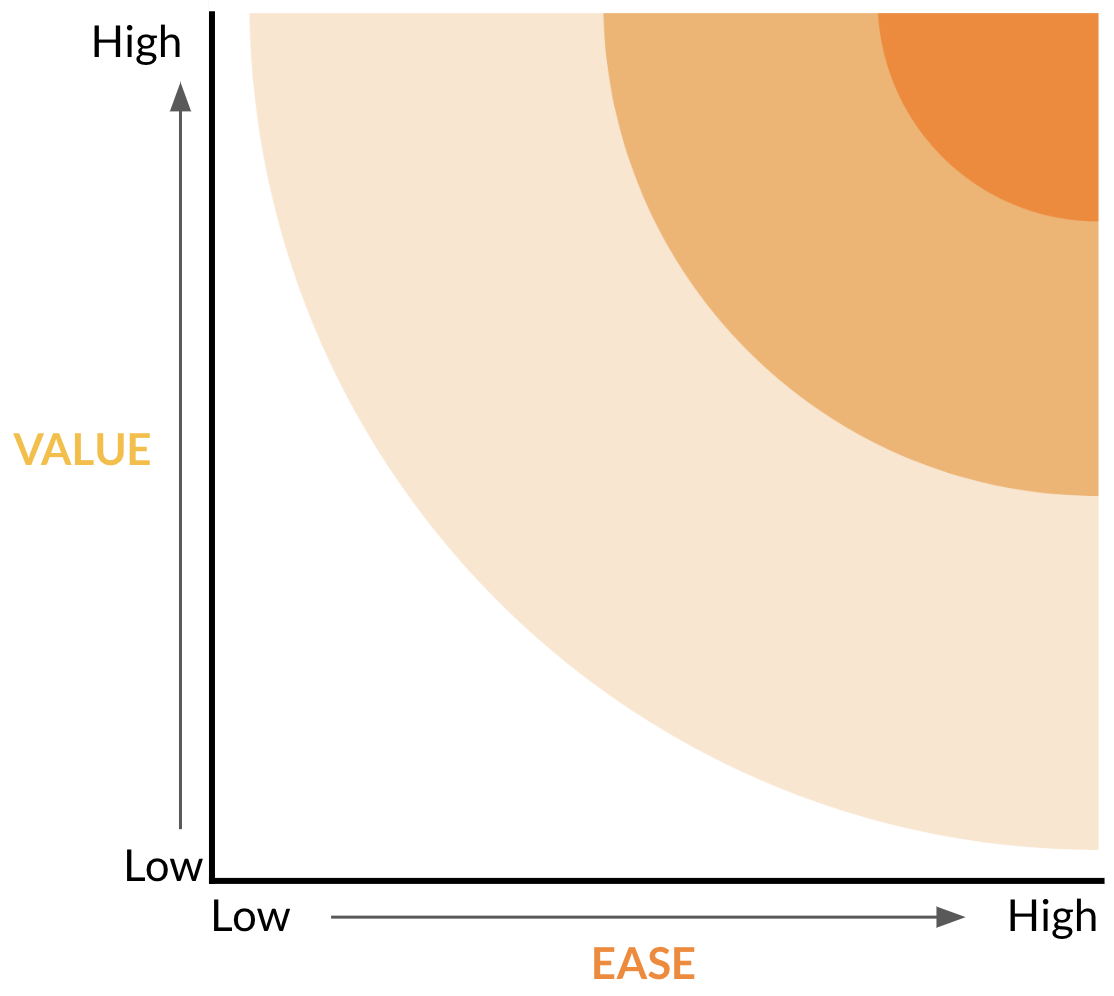
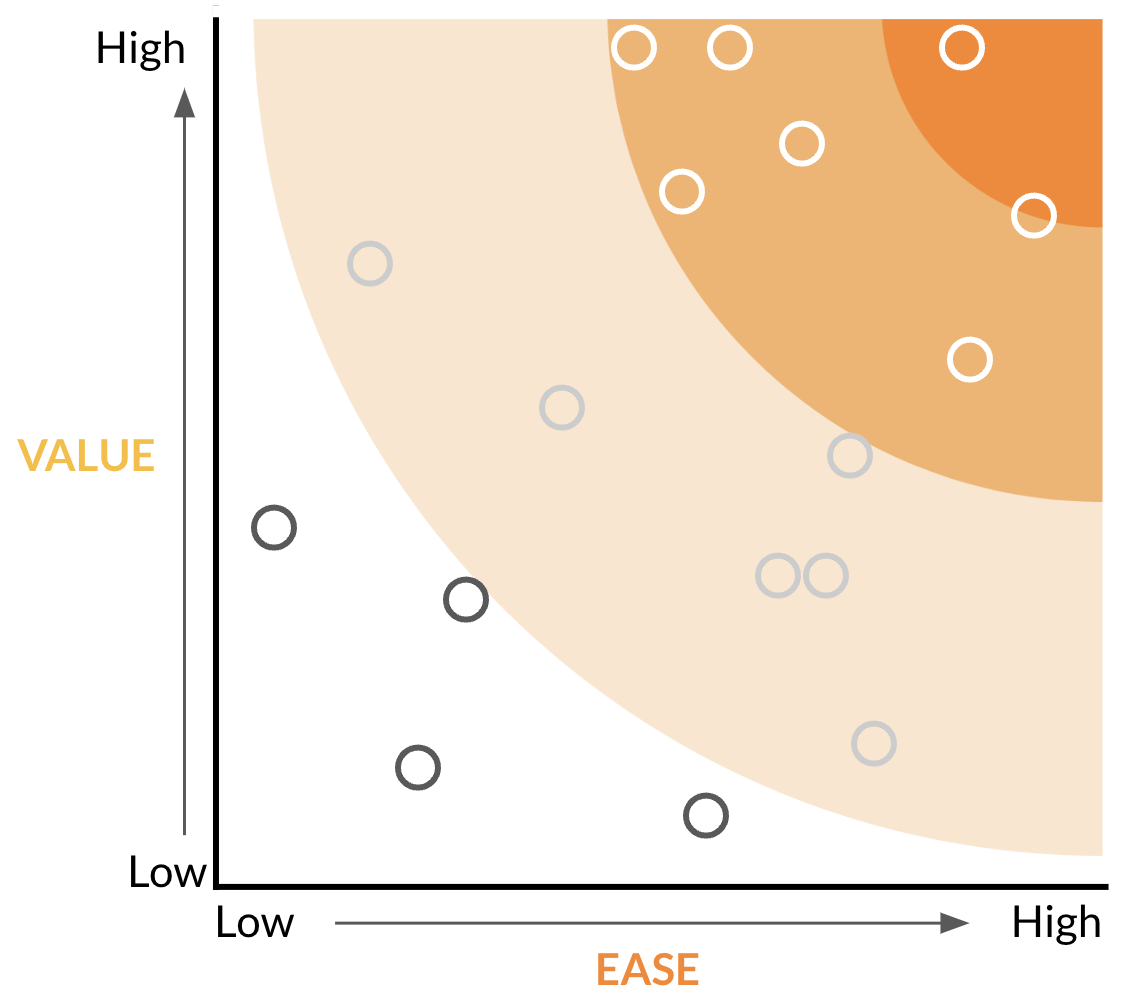
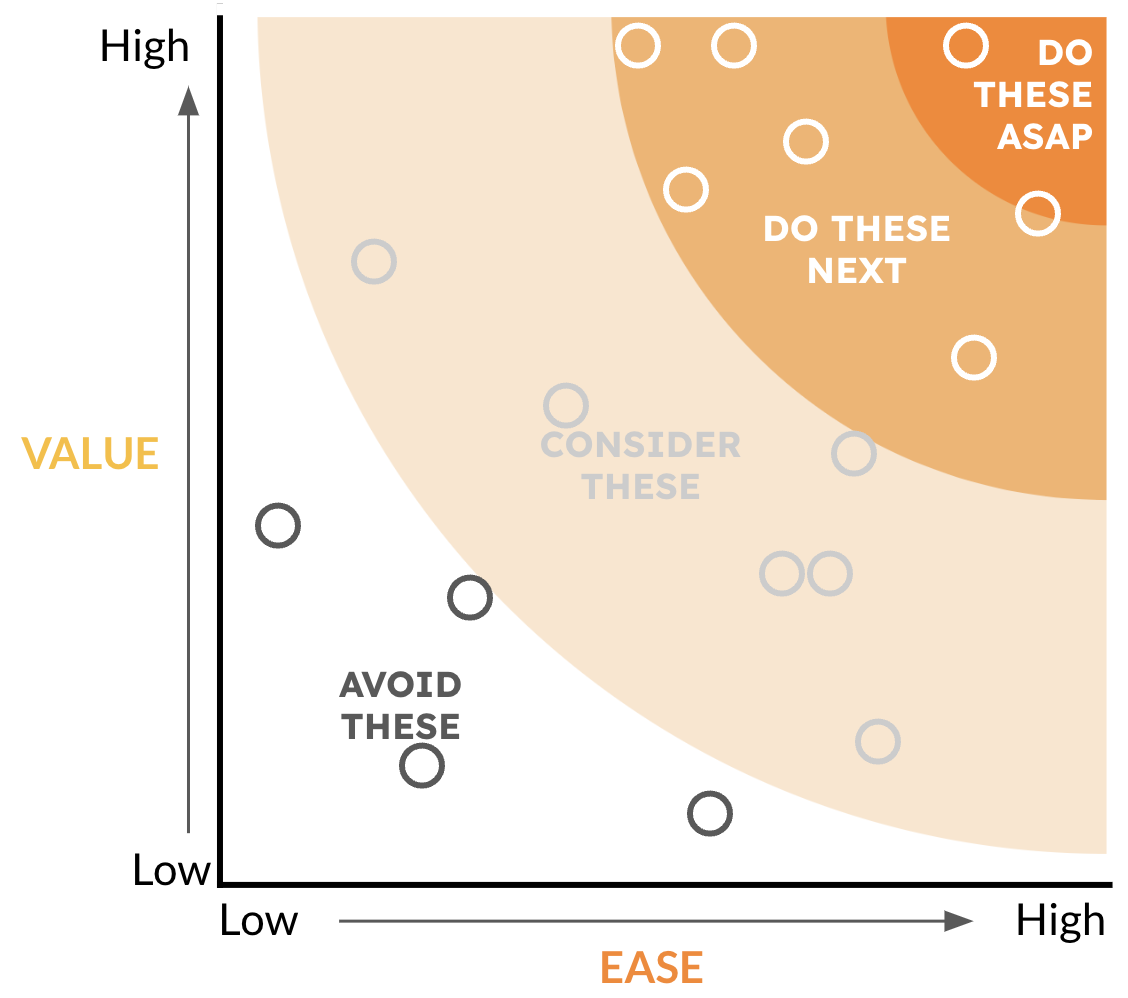
    In order to put resources where they can deliver the most value, we recommend plotting each potential initiative on a value / ease matrix. You can consider “ease” to include a non-scientific mix of people, stress, financial investment, etc, or you may be more specific depending on your situation. Admittedly, this method is oversimplified and relies on a lot of assumptions, but it is a pragmatic way to quickly review the attractiveness of each potential initiative.

    Too often, companies skip this step and end up working on a sub-optimal set of initiatives. McKinsey states that the “most attractive projects combine high value and low complexity. However, many companies will find that they are focusing on the least attractive projects (low value and high complexity).”

    Plotting your initiatives on this matrix help you identify the right ones to pursue. By focusing limited resources where they will have the most value and highest ease (further to the top-right), you stand a better chance of achieving your overall ambition. 

    And once you’ve identified your initiatives, stratsuma is here to help you define them in more detail and track their progress as they come to life.

  • A Progress Tracker isn’t a Performance Review

    The first time I saw a progress tracker also happened to be the first time I saw an all-green one. “Wow,” I thought, “they must have it all together.” In the years since, despite seeing probably hundreds of all-green progress trackers, I’ve never seen a perfect transformation – so why the disconnect?

    The typical traffic light system—Red, Amber, Green (RAG)—is a common way to assess the health of transformation initiatives. Green indicates everything is going according to plan; Amber suggests some risks or issues are present, but they’re manageable; and Red signals that there are significant problems or that an initiative is off track. Teams are often permitted (as they are with stratsuma) to self-report the status of their own initiatives. 

    All-green trackers often hide more than they reveal. They look promising on the surface, but they may also signal that teams aren’t feeling safe enough to report the reality of their challenges, or aren’t close enough to the detail that they spot issues in the first place. Many of these teams struggle to differentiate their performance from the health of their initiative. Imagine an emergency room doctor doing the same thing – marking all their patients as Green to try and show their leaders that they’re a good doctor, despite the health of several patients clearly being Amber or Red.

    Too often we assume that a Green status is the ultimate indicator of success. It’s easy to think that if our initiative is green, our leaders will think highly of us. But in reality, the absence of reported issues can be a red flag in itself. When teams feel safe to mark their initiatives as Red or Amber, leaders can take immediate action to mitigate risks and help solve problems to get the initiative back on track.

    Research from Bain & Company supports this. Their study, which analyzed data from 24,000 transformation initiatives, revealed a startling truth: 50% of initiatives that were underperforming reported a Green status throughout the entire process. Conversely, a third of initiatives that were flagged as Red (off track) showed improvement in performance over time. This suggests that teams who report honestly—even when things are going wrong—are more likely to get back on track and achieve the desired outcomes.

    Leaders who treat Red and Amber statuses as signs of failure discourage their teams from raising early warnings, leading to delayed responses to emerging issues, ultimately costing time and resources. Conversely, Leaders should promote a culture where it’s safe for teams to report challenges honestly, without fear of repercussion. Red and Amber shouldn’t be seen as a reflection of failure; they are indicators of active problem-solving.

    The most successful transformations aren’t those that stay perpetually green; they’re the ones that allow for honest conversations about what’s going wrong and what needs to be fixed. As a leader, it’s crucial to foster an environment where Red and Amber are seen not as negative indicators, but as opportunities to uncover deeper insights and address potential risks early on. By embracing transparency and creating a culture where teams feel safe to report the truth—no matter how uncomfortable—you’re setting the stage for more resilient, successful transformations.

  • Progress Beats Perfection

    We’ve all encountered the perfectionist in the workplace – always revising, re-doing, and re-tweaking their work until finally satisfying a ridiculously high (and yet subjective) bar. And we’ve all met the scrappy pragmatist who cobbles things together and quickly moves on to the next task. The perfectionist’s commitment to quality is oftentimes admirable, but their relentless pursuit of perfection often puts them behind the pragmatist in getting things done.

    A culture of perfectionism is often a real problem. It stifles creativity and leads to a fear of making mistakes, both of which get in the way of innovation. Perfectionism drives builders away. Embracing a culture or expectation of perfection can lead to burnout and a decline in team spirit. Perfectionism is often guilty of slowing the work and wasting resources on things that don’t actually make a difference. 

    For example, it is common for big tech companies to hire highly-paid ex-consultants with the expectation to solve thorny problems, only to have them spend hours beautifully formatting an executive document which could instead have been summarized in a 20-word email, or to spend a week creating a 50-page appendix on the off-chance that an executive asks a specific question.

    Shifting your focus from achieving perfection to embracing progress unlocks a multitude of benefits. Pragmatism, when coupled with the freedom to take risk and make mistakes, allows companies to move from idea to execution quicker. A pragmatic mindset allows for agility and adaptation, and creates a culture of continuous learning within your organization. 

    But to be fair, there are instances where a desire to be perfect is warranted. For example, a NASA engineer tasked with bringing astronauts safely back to earth absolutely needs to be perfect, because the consequences of failure could be disastrous. However, the stakes are a little different for an advertiser testing ad copy, who can be a lot more pragmatic as they learn what drives clicks to a website.

    Almost all of the time, we are in the position of the Ads tester, not the NASA engineer. Concerning strategy, James Schoen, Co-Founder of Trumbug explains that “a good strategy is clear, concise, and easily understood by those who have to execute it. Even if it’s not the perfect direction, if everyone is aligned and working towards a common goal, you’re likely to be somewhat successful.” In James’ example, it is progress that makes the difference, despite the lack of perfection.

    Here are some things we’ve learned to favor progress over perfection:

    • Ask “what happens if.” Instead of defaulting to perfect, ask yourself what happens if you don’t finish on time, what happens if your email has spelling errors, what happens if the colors, font size, etc. aren’t on brand? You’ll often realize that nothing serious will happen, showing you that you don’t need to be perfect.
    • Determine the “definition of done.” Identify the minimum viable product (or what are the bare minimum requirements) for each item you need to deliver before you start work. This will help you avoid feeling compelled to add a bunch of unnecessary bells and whistles to whatever you are doing.
    • Prioritize Ruthlessly. Remember that in most cases you have many other things that need to be done, and you’ll need to simplify, delegate or eliminate tasks from your list. Keeping in mind the next important task on your list helps you move on instead of having too many tasks pile up!
    • Embrace Iteration. Recognize that much of the important work you do will end up having to evolve over time. Understanding what you need to get done before the next round of feedback helps to avoid aiming for perfection at every step. For example, if you’re working on a slide deck, tell your supervisor you only want feedback on the content, not the format in this particular iteration.
    • Celebrate progress: Acknowledge and celebrate progress, both of things that have worked out, but also on things that failed and led to learnings. This recognition keeps teams motivated while remaining them that it is OK to fail, so long as you learn.