Passionate business leaders typically find it easy to draw up a long list of potential initiatives their teams could pursue as part of their strategy. As an example, think of the founders of a software company who can spin up a never-ending list of features they’d like to build for their product, each of which solve a customer pain point.
But in any business, especially start ups, resources are limited, and initiatives (or features) need to be prioritized. In the words of McKinsey & Company, resources are often in “short supply, making it important to put [them] toward changes that will deliver the most value.”
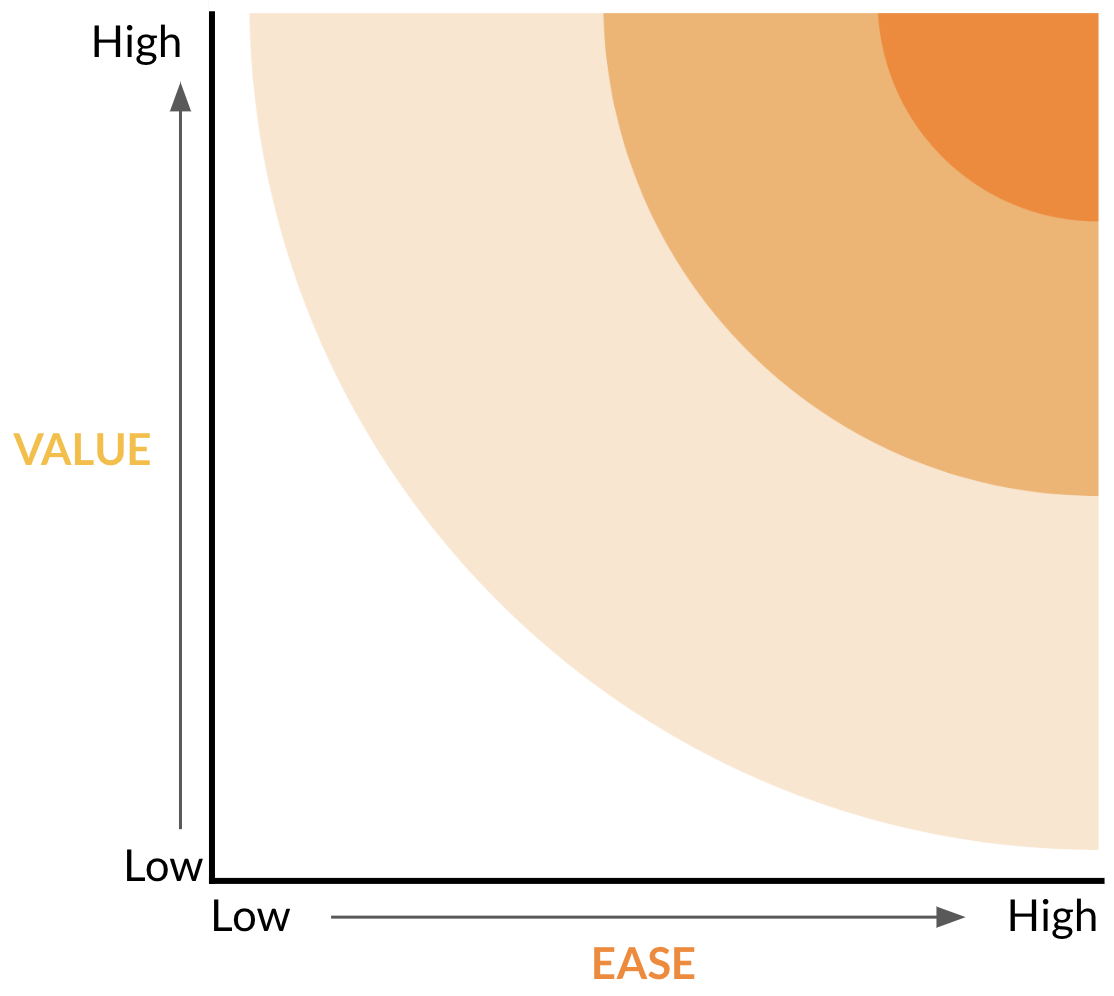
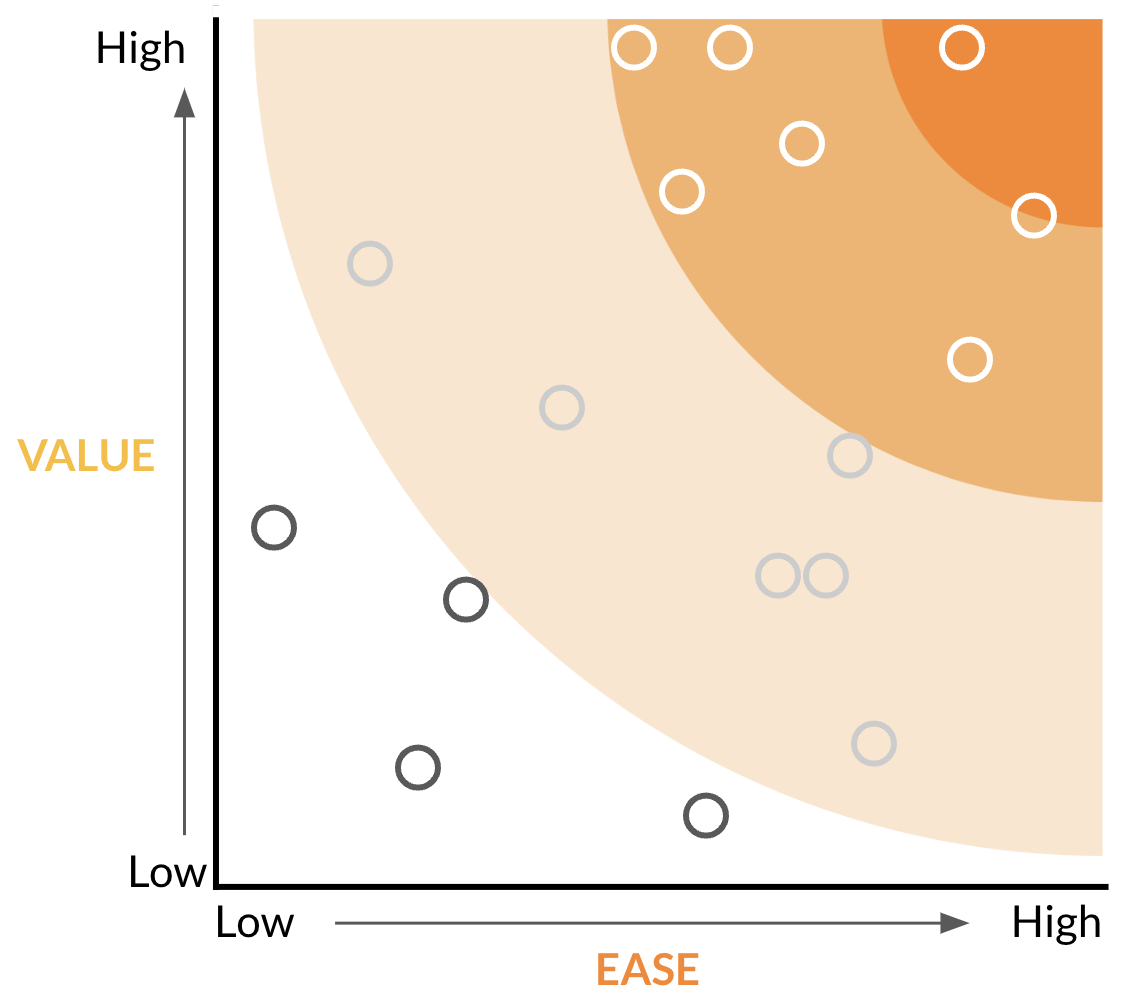
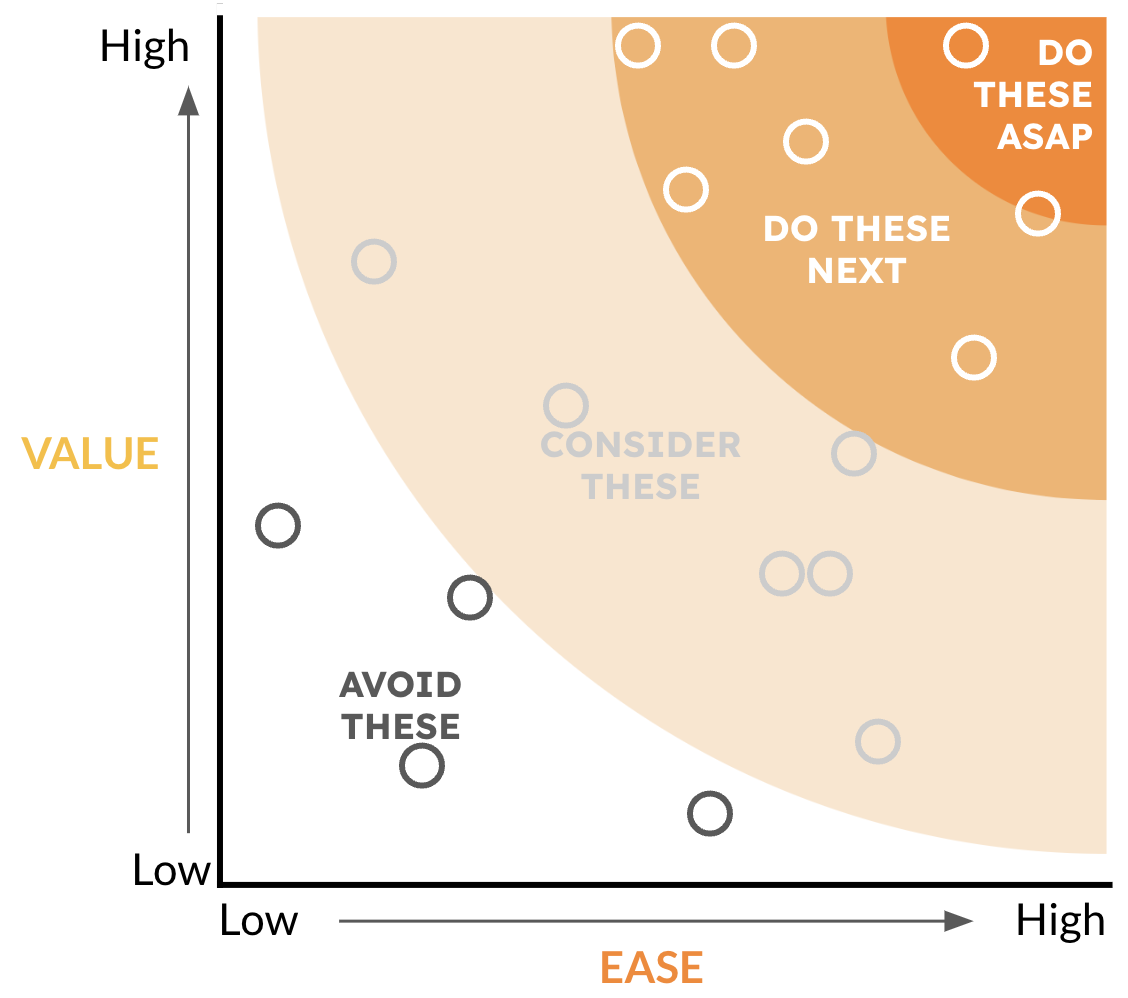
In order to put resources where they can deliver the most value, we recommend plotting each potential initiative on a value / ease matrix. You can consider “ease” to include a non-scientific mix of people, stress, financial investment, etc, or you may be more specific depending on your situation. Admittedly, this method is oversimplified and relies on a lot of assumptions, but it is a pragmatic way to quickly review the attractiveness of each potential initiative.
Too often, companies skip this step and end up working on a sub-optimal set of initiatives. McKinsey states that the “most attractive projects combine high value and low complexity. However, many companies will find that they are focusing on the least attractive projects (low value and high complexity).”
Plotting your initiatives on this matrix help you identify the right ones to pursue. By focusing limited resources where they will have the most value and highest ease (further to the top-right), you stand a better chance of achieving your overall ambition.
And once you’ve identified your initiatives, stratsuma is here to help you define them in more detail and track their progress as they come to life.
It’s easier to pick a new cereal than a new home. Sounds obvious, but why? Well, picking between Lucky Charms and Honey Nut Cheerios is a pretty insignificant decision with next to no risk. Worst case – you have to head back to the store and try another option. But buying the right home? You have to invest time in searching, fill out endless amounts of paperwork, secure a mortgage, pack up and sell your current home, hire movers, say goodbye to old friends and make new ones, and so on. If you don’t like the new home, you can’t just simply head to the store and return home with the new one in a couple of minutes.
We refer to these kinds of decisions as two-way doors and one-way doors. Two-way doors are low risk and easily reversible, like picking cereal, while one-way doors have serious consequences that you can’t simply ignore or undo, such as choosing a home.
What Kind of Door is This?
When making choices, decision makers must understand the type of door they are facing. Approaching a two-way door as though it were one-way wastes time and resources, while treating a one-way door as two-way can land you in hot water, fast. One way to determine which kind of decision you are facing is to ask “what happens if I get this decision wrong?” If the answer is serious, you’re looking at a one-way door. If the answer is no big deal, its a two-way door.
Never Walk Blindly Through a One-Way Door
When you identify a one-way door, your decision on whether to go through requires very careful consideration. As Jeff Bezos explains in Amazon’s 2016 letter to shareholders, “these decisions must be made methodically, carefully, slowly, with great deliberation and consultation. If you walk through and don’t like what you see on the other side, you can’t get back to where you were before.”
As an example, imagine you’re a CEO targeting 50% revenue growth in the next 3 years. One of your options is a major pivot to put GenAI at the core of your business. Your research suggests that this can open up significant growth opportunities, but doing so requires a huge investment in a new and relatively untested technology. The majority of your team doesn’t have the required expertise, so you will likely need to hire new staff. Going ahead with the GenAI pivot is a one-way door – a significant decision that, once made, can’t simply be undone without enormous consequences.
Here are some other examples of one-way doors:
Mergers and Acquisitions: Acquiring a competitor is a bold move which typically requires painful integration efforts, but it comes with high rewards if successful.
Product Pivots: Completely changing your core product or service is a major gamble, but sometimes necessary to stay ahead of the curve.
Long-Term Contracts: Signing a multi-year deal with a key vendor locks you in, but may come with favorable commercial terms.
Accepting Investment: Taking money from investors requires you to give up a piece of your company, but can give you the capital you need to grow.
Don’t Waste Too Much Time Analyzing Two-Way Doors
When you identify a two-way door, the decision of whether to go through is much easier. Two-way doors are all about learning on the fly and adapting to new information, in a much lower stakes environment, as Bezos explains “you don’t have to live with the consequences for that long. You can reopen the door and go back through.” Use your best judgment to make a quick decision and test new ideas, learn from setbacks (remember, even failures can be valuable lessons), and adjust your course as needed.
Here are some other examples of two-way doors:
A/B Testing: Experiment with different marketing campaigns or website layouts to see what resonates best with your target audience.
Minimum Viable Products (MVPs): Launch a stripped-down version of your new technology to gather user feedback before full-scale development.
Piloting New Processes: Test a new workflow within a small team before rolling it out company-wide.
Find Ways to Create Two-Way Doors
The most creative leaders find ways to test the biggest decisions with two-way doors. Returning to our home buyer example, let’s say you are thinking of moving out of a busy city and buying a home in the countryside. Family is close by, and the area has outstanding natural beauty. But you’ve never lived there before, you aren’t sure how you feel about the quieter life and the significantly longer commute.
In this situation, you might delay the one-way door (buying a home in the area), and instead create a two-way door by staying in a rental for a few months. This gives you the opportunity to experience the quiet and whether you can handle the commute. This two-way door essentially becomes a pilot as part of the one-way door’s research, to ensure you make the most informed decision possible!