Passionate business leaders typically find it easy to draw up a long list of potential initiatives their teams could pursue as part of their strategy. As an example, think of the founders of a software company who can spin up a never-ending list of features they’d like to build for their product, each of which solve a customer pain point.
But in any business, especially start ups, resources are limited, and initiatives (or features) need to be prioritized. In the words of McKinsey & Company, resources are often in “short supply, making it important to put [them] toward changes that will deliver the most value.”
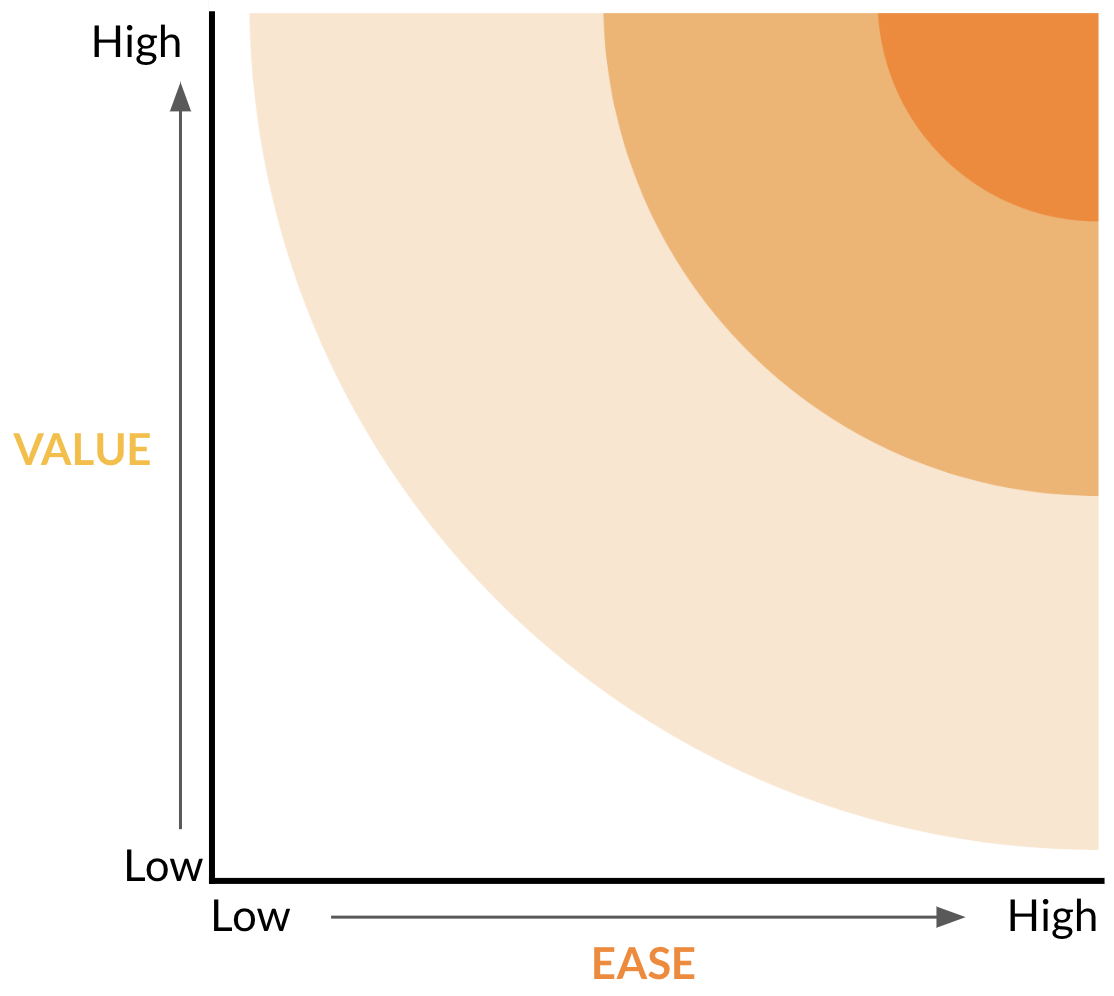
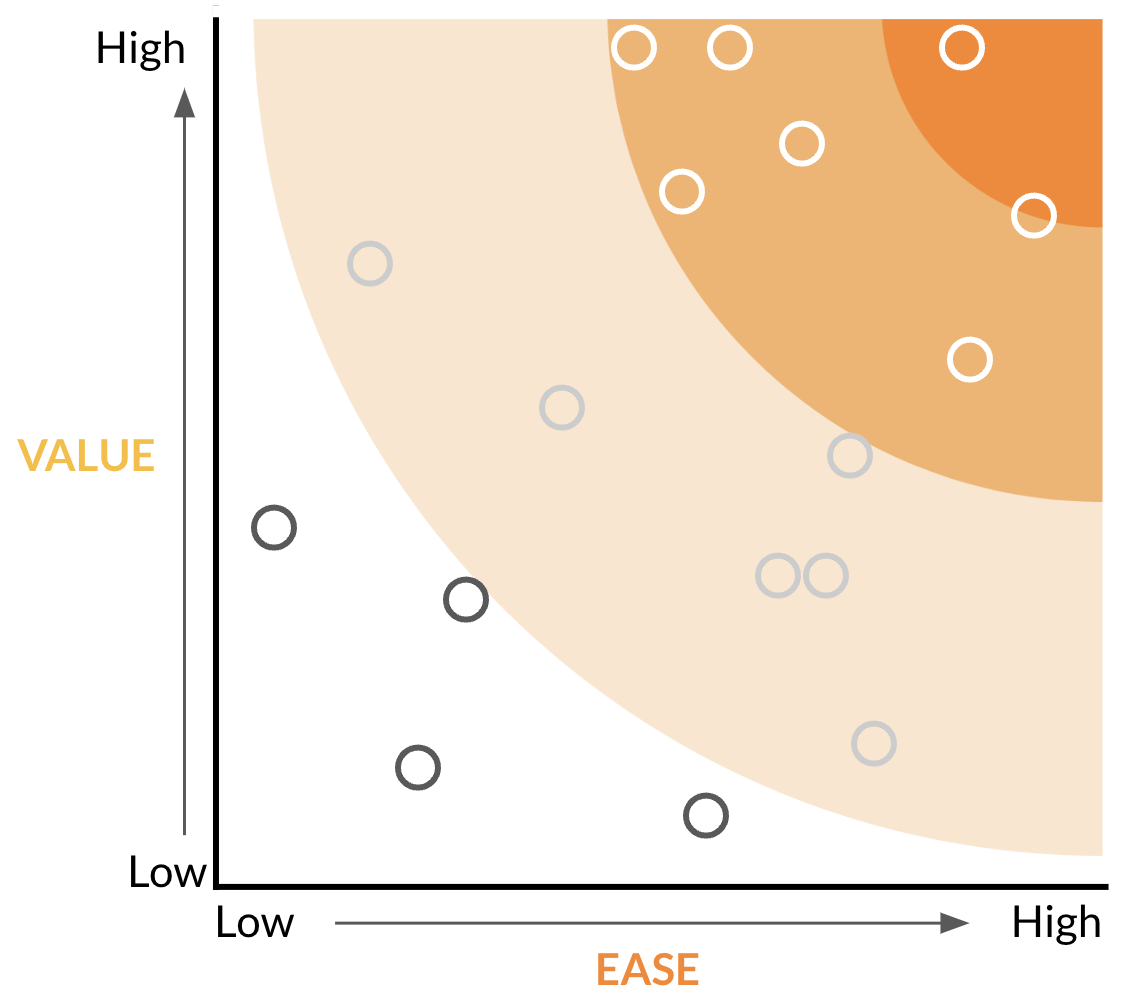
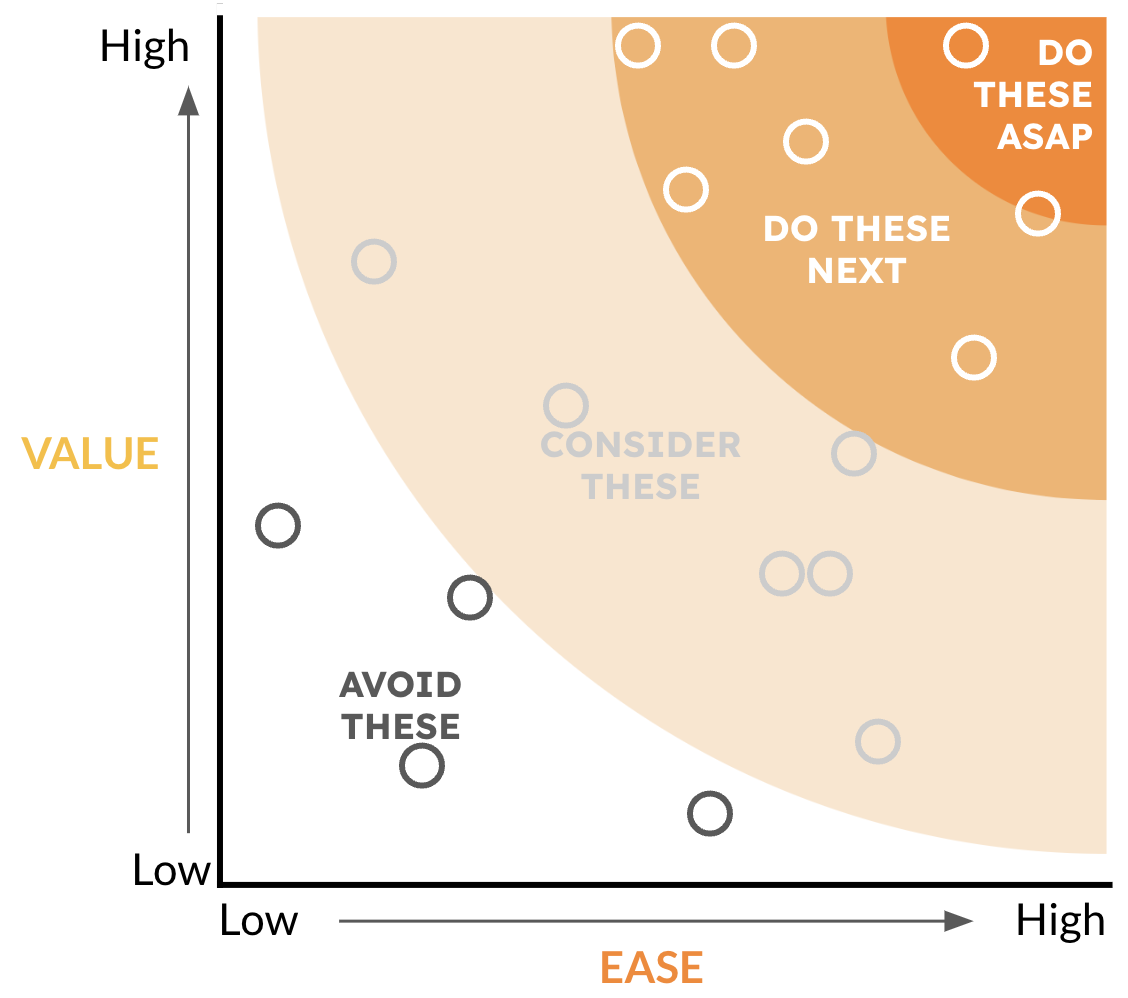
In order to put resources where they can deliver the most value, we recommend plotting each potential initiative on a value / ease matrix. You can consider “ease” to include a non-scientific mix of people, stress, financial investment, etc, or you may be more specific depending on your situation. Admittedly, this method is oversimplified and relies on a lot of assumptions, but it is a pragmatic way to quickly review the attractiveness of each potential initiative.
Too often, companies skip this step and end up working on a sub-optimal set of initiatives. McKinsey states that the “most attractive projects combine high value and low complexity. However, many companies will find that they are focusing on the least attractive projects (low value and high complexity).”
Plotting your initiatives on this matrix help you identify the right ones to pursue. By focusing limited resources where they will have the most value and highest ease (further to the top-right), you stand a better chance of achieving your overall ambition.
And once you’ve identified your initiatives, stratsuma is here to help you define them in more detail and track their progress as they come to life.
We’ve all encountered the perfectionist in the workplace – always revising, re-doing, and re-tweaking their work until finally satisfying a ridiculously high (and yet subjective) bar. And we’ve all met the scrappy pragmatist who cobbles things together and quickly moves on to the next task. The perfectionist’s commitment to quality is oftentimes admirable, but their relentless pursuit of perfection often puts them behind the pragmatist in getting things done.
A culture of perfectionism is often a real problem. It stifles creativity and leads to a fear of making mistakes, both of which get in the way of innovation. Perfectionism drives builders away. Embracing a culture or expectation of perfection can lead to burnout and a decline in team spirit. Perfectionism is often guilty of slowing the work and wasting resources on things that don’t actually make a difference.
For example, it is common for big tech companies to hire highly-paid ex-consultants with the expectation to solve thorny problems, only to have them spend hours beautifully formatting an executive document which could instead have been summarized in a 20-word email, or to spend a week creating a 50-page appendix on the off-chance that an executive asks a specific question.
Shifting your focus from achieving perfection to embracing progress unlocks a multitude of benefits. Pragmatism, when coupled with the freedom to take risk and make mistakes, allows companies to move from idea to execution quicker. A pragmatic mindset allows for agility and adaptation, and creates a culture of continuous learning within your organization.
But to be fair, there are instances where a desire to be perfect is warranted. For example, a NASA engineer tasked with bringing astronauts safely back to earth absolutely needs to be perfect, because the consequences of failure could be disastrous. However, the stakes are a little different for an advertiser testing ad copy, who can be a lot more pragmatic as they learn what drives clicks to a website.
Almost all of the time, we are in the position of the Ads tester, not the NASA engineer. Concerning strategy, James Schoen, Co-Founder of Trumbug explains that “a good strategy is clear, concise, and easily understood by those who have to execute it. Even if it’s not the perfect direction, if everyone is aligned and working towards a common goal, you’re likely to be somewhat successful.” In James’ example, it is progress that makes the difference, despite the lack of perfection.
Here are some things we’ve learned to favor progress over perfection:
Ask “what happens if.” Instead of defaulting to perfect, ask yourself what happens if you don’t finish on time, what happens if your email has spelling errors, what happens if the colors, font size, etc. aren’t on brand? You’ll often realize that nothing serious will happen, showing you that you don’t need to be perfect.
Determine the “definition of done.” Identify the minimum viable product (or what are the bare minimum requirements) for each item you need to deliver before you start work. This will help you avoid feeling compelled to add a bunch of unnecessary bells and whistles to whatever you are doing.
Prioritize Ruthlessly. Remember that in most cases you have many other things that need to be done, and you’ll need to simplify, delegate or eliminate tasks from your list. Keeping in mind the next important task on your list helps you move on instead of having too many tasks pile up!
Embrace Iteration. Recognize that much of the important work you do will end up having to evolve over time. Understanding what you need to get done before the next round of feedback helps to avoid aiming for perfection at every step. For example, if you’re working on a slide deck, tell your supervisor you only want feedback on the content, not the format in this particular iteration.
Celebrate progress: Acknowledge and celebrate progress, both of things that have worked out, but also on things that failed and led to learnings. This recognition keeps teams motivated while remaining them that it is OK to fail, so long as you learn.
According to Bain & Company, a staggering 88% of business transformations fail to achieve their original ambitions. That’s an unbelievable amount, considering the amount of time, resources, and energy poured into these transformations. With so much at stake, how can you bridge the gap between ambitious plans and disappointing outcomes? A good place to start is realizing that transformations are not one-time events, but longer journeys requiring clear direction and sustained effort.
A fitness example will resonate with many of us: have you ever embarked on a fitness journey, only to see that journey fizzle out prematurely? Maybe you’ve had a goal to run a marathon in an ambitious time – you’ve bought a nice pair of running shoes and paid your race registration, but without a solid training plan, and mechanisms to keep you accountable to it, progress stalls, and motivation dwindles. Next thing you know, it’s race weekend and you’re nowhere near your target time, or maybe you didn’t even show up to the race at all.
This is what happens with 88% of transformations. Leaders get excited about the possibilities a transformation brings, but fail to translate that excitement properly into a practical roadmap and see its execution through to success. Let’s break down some key elements missing from many failed transformations:
Clear Strategy: Transformations need a north star that everyone can understand and rally behind. This “strategy on a page” should outline the company’s ambition and the key initiatives for achieving it.
Actionable Initiatives: Initiatives need to be defined in detail so that teams can bring them to life. Initiative charters are crucial here. These documents define scope, deliverables, timelines, and assigned team members, to help bring the direction teams need for execution.
Accountability and Progress Tracking: Regularly tracking initiative progress against defined charters keeps motivation high and helps teams maneuver around roadblocks. Without governance and accountability, teams lose focus, and execution wanes.
By implementing these key elements, teams can avoid the 88% trap and successfully achieve their ambitions. Tools like stratsuma empower businesses to navigate their transformation journeys with confidence and achieve lasting success. Learn more about how stratsuma can help you navigate your transformation journey today.